
Why Early Orthodontic Expansion Matters: How Phase 1 Treatment Improves Airway and Prevents Crowding
What Is Phase 1 Orthodontic Treatment?
Phase 1 orthodontics—also known as early interceptive orthodontic treatment—focuses on guiding jaw growth and dental development in children, typically between ages 6–10.
At this stage, the goal is not just to straighten teeth, but to address underlying structural issues such as:
- Narrow dental arches
- Crossbites
- Severe crowding
- Improper jaw development
- Early signs of airway deficiency
By intervening early, orthodontists can leverage natural growth to create long-term improvements in both function and facial development.
Clinical Case Overview: Early Expansion in a Narrow Arch Patient
In this case, the patient presented with several key orthodontic and airway concerns:
- Constricted upper arch with limited space for erupting teeth
- Severe crowding in both upper and lower arches
- A developing posterior crossbite
- A visibly narrow smile
- Early signs and symptoms of airway deficiency
These findings are commonly associated with restricted maxillary development, which can impact not only dental alignment but also nasal breathing and airway volume.
How Palatal Expansion Works
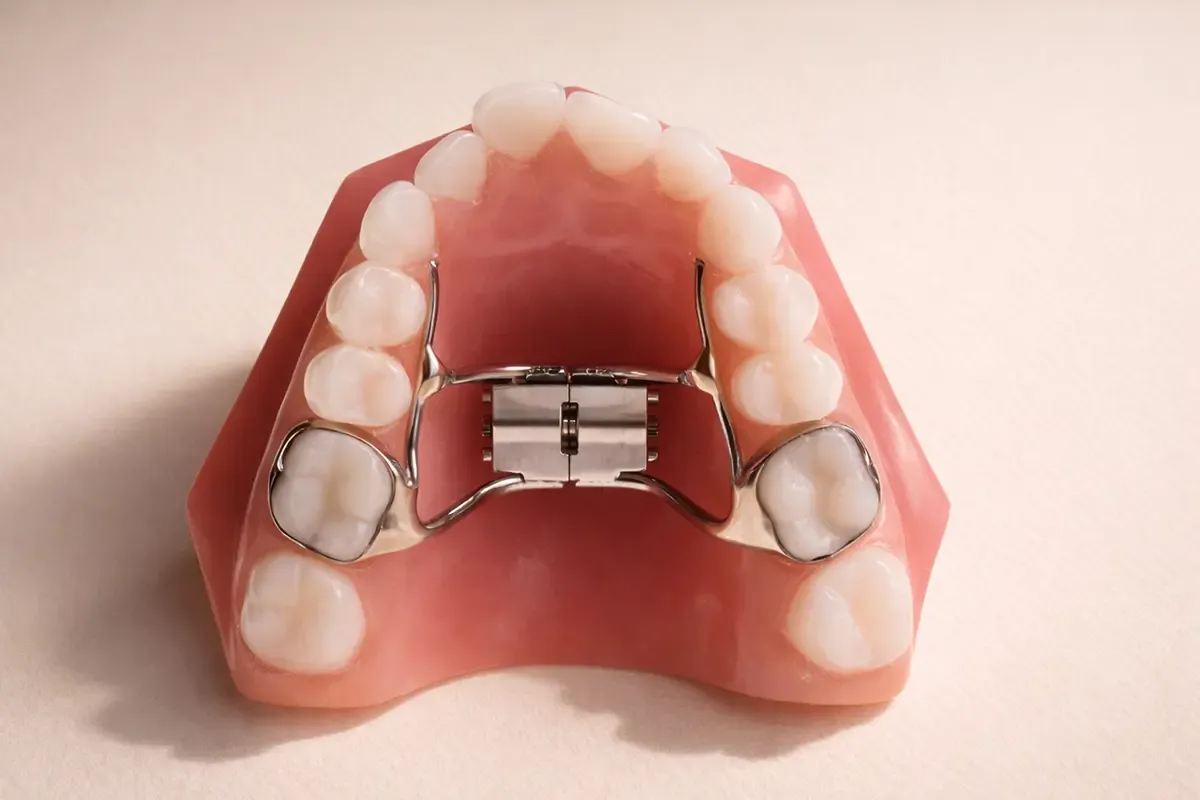
To address these issues, a palatal expander was placed to gradually widen the upper jaw.
Mechanism of Action
Palatal expanders apply gentle, controlled forces to the midpalatal suture, allowing the maxilla (upper jaw) to widen over time.
Activation Protocol
In this case, expansion was performed using a consistent activation schedule, allowing for:
- Controlled skeletal expansion
- Minimal discomfort
- Predictable and stable outcomes
Results After Just 6 Weeks of Expansion
Within just six weeks of treatment, significant improvements were already visible:
- Expansion of the upper arch, increasing available space
- Previously blocked teeth began erupting into proper position
- Improved arch form and symmetry
- Reduction in crowding severity
These early changes highlight how effective growth-guided orthodontic treatment can be when performed at the right developmental stage.
The Connection Between Orthodontics and Airway Development
Modern orthodontics goes beyond aesthetics. There is a growing body of research linking maxillary constriction to airway limitations.
Why Airway Matters
A narrow upper jaw can contribute to:
- Mouth breathing
- Poor sleep quality
- Snoring or pediatric sleep-disordered breathing
- Altered facial growth patterns
How Expansion Helps
By widening the maxilla, palatal expansion can:
- Increase nasal airway volume
- Promote nasal breathing
- Support healthier facial and skeletal development
This approach is often referred to as airway-driven orthodontics.
Why Timing Is Critical in Early Orthodontic Treatment
One of the most important factors in successful Phase 1 treatment is timing.
During childhood, the jaw is still developing, and the midpalatal suture has not yet fused. This allows for:
- More effective skeletal changes
- Reduced need for tooth extractions later
- Lower likelihood of surgical intervention in adolescence or adulthood
Delaying treatment can result in:
- Increased crowding
- More complex orthodontic needs
- Potential need for jaw surgery in severe cases
Benefits of Phase 1 Orthodontics
Early orthodontic intervention provides both functional and long-term health benefits, including:
- Creating space for permanent teeth
- Correcting crossbites early
- Improving airway and breathing
- Enhancing facial symmetry and development
- Reducing treatment complexity in Phase 2
- Supporting long-term stability of results
Phase 1 Orthodontics in Northern Virginia
At Elite Orthodontics, we specialize in airway-focused early orthodontic treatment for children across Northern Virginia.
We proudly serve families in:
Our approach combines clinical precision with advanced growth-guided techniques to ensure each child receives the right treatment at the right time.
When Should Your Child See an Orthodontist?
The American Association of Orthodontists recommends an evaluation by age 7.
Early signs your child may benefit from Phase 1 treatment include:
- Crowded or blocked-out teeth
- Narrow smile or small upper jaw
- Crossbite or underbite
- Mouth breathing or snoring
- Difficulty chewing or biting
Schedule a Consultation
If your child is showing signs of crowding, bite issues, or airway concerns, early evaluation can make a significant difference.
Schedule a consultation with Elite Orthodontics today to determine if Phase 1 treatment is appropriate.
📍 Multiple locations across Northern Virginia
📲 Convenient online booking available